
Rachin
How a Digital Marketing Course Can Help You Build a Career Portfolio Before Your First Job
Table of Contents
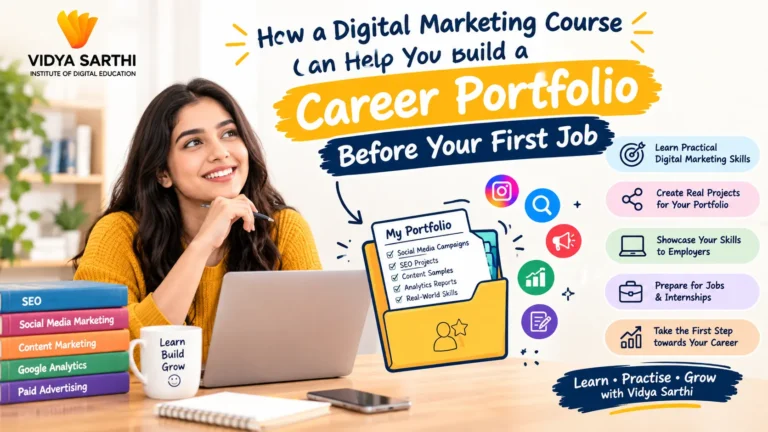
Starting a career can feel confusing, especially when you are applying for your first job. You may have learned many things during your studies, but employers often want to see how you can use that knowledge in real situations.
This is where a career portfolio can help.
A portfolio is a collection of your work that shows what you can do. It can include projects, campaign plans, content samples, reports, and other examples of your skills. You do not need to wait until you get your first job to start building one.
A digital marketing course can give you opportunities to practise important skills and create work samples that you can show to potential employers. It can help you move beyond learning concepts and start applying them.
In this blog, we will explore how a digital marketing course can help you build a career portfolio before your first job, and how that portfolio can support your search for jobs and internships.
1. Why a Digital Marketing Course Can Help You Build a Strong Portfolio
When you are a fresher, you may not have professional work experience. This does not mean you have nothing to show.
You can create practice projects that demonstrate your understanding of digital marketing. These projects can help employers see how you approach a task, organise your ideas, and solve a problem.
For example, you could create a sample social media strategy for a local café, prepare an SEO audit for a demo website, or design a content calendar for a small business.
These projects do not need to be created for a real client. You should simply be clear that they are practice or portfolio projects.
A structured digital marketing course can help you understand what to include in these projects and how to present them professionally.
The goal is to show that you can apply what you have learned—not just list the topics you studied.
2. Build a Social Media Marketing Portfolio With Practical Projects
Social media marketing is an important area of digital marketing. Businesses use platforms such as Instagram, Facebook, and LinkedIn to connect with audiences, share information, and promote their products or services.
A portfolio can show that you understand how to plan social media content and communicate with a specific audience.
You could create a sample project for a fictional business, such as a clothing store, bakery, fitness studio, or educational institute.
Your project might include:
A short description of the business and its target audience
Social media goals
A content calendar for one month
Sample posts and captions
Ideas for Reels or short videos
A plan to encourage engagement
For example, you could prepare a one-week Instagram content plan for a local bakery. Include a product post, a behind-the-scenes Reel, a customer question, and a helpful post about choosing a cake for an event.
This project can demonstrate your creativity and your ability to plan content with a purpose.
3. Use SEO Projects to Demonstrate Your Digital Marketing Skills
Search Engine Optimisation, or SEO, helps websites improve their visibility in search engine results. It is a useful skill to demonstrate in a career portfolio because it involves research, planning, and attention to detail.
A digital marketing course may introduce you to keyword research, on-page SEO, content optimisation, and website analysis. You can use these concepts to create a sample SEO project.
For example, choose a demo website or a fictional business and prepare a basic SEO audit.
Your portfolio project could include:
A list of relevant keywords
Suggested page titles and meta descriptions
Recommendations for heading structure
Ideas for improving website content
Internal linking suggestions
A simple list of technical issues to investigate
You do not need to claim that your recommendations improved rankings if you have not tested them. Instead, explain what you analysed and why you made each recommendation.
This shows employers that you understand the process and can explain your decisions.
4. Create a Content Marketing Portfolio With Blog Writing
Content marketing is about creating useful and relevant information for a target audience. It can include blogs, social media posts, email newsletters, guides, and other formats.
If you enjoy writing, content marketing can be a good area to include in your portfolio.
You could create a small collection of content samples, such as:
A blog post on a topic related to a business
A social media caption
A short email newsletter
A product description
A simple content plan
For example, you might write a blog explaining how a small business can improve its social media presence. You can also include a short note describing the target audience, primary keyword, and purpose of the article.
This demonstrates that you can write for a business objective rather than only for general information.
A well-organised writing portfolio can be especially useful when applying for content marketing, social media, or digital marketing roles.
5. Learn Analytics and Show How You Measure Digital Marketing Results
Digital marketing is not only about creating content or launching campaigns. It also involves understanding how people respond to that content.
Analytics helps marketers review performance and make informed decisions.
You can include a sample analytics report in your portfolio. Use a practice dataset or clearly labelled hypothetical figures if you do not have access to real campaign data.
Your report could show:
Reach and impressions
Engagement rate
Website visits
Click-through rate
Leads or enquiries
Recommendations for improvement
For example, you could explain that a sample campaign received more engagement on educational posts than on promotional posts. You might recommend testing more educational content in the next campaign.
The important part is explaining what the data suggests and what you would do next.
This can show employers that you are thinking beyond numbers and using them to make decisions.
6. Use a Digital Marketing Course to Prepare for Jobs and Internships
When applying for jobs or internships, a portfolio can give you something concrete to discuss during an interview.
Instead of saying, “I know social media marketing,” you can show a content calendar you created and explain how you selected the topics.
Instead of saying, “I understand SEO,” you can walk an interviewer through your sample SEO audit.
This can help make your skills easier to understand.
Your portfolio may be useful when applying for roles such as:
Digital marketing intern
Social media marketing intern
SEO trainee
Content marketing intern
Digital marketing executive
Junior marketing assistant
You should still tailor your resume and portfolio to each role. If the job focuses on SEO, highlight your SEO project. If it focuses on social media, show your content planning and creative work.
A portfolio does not guarantee a job, but it can help you present your skills more clearly and confidently.
7. Organise Your Digital Marketing Portfolio Professionally
Creating projects is one part of the process. Presenting them clearly is equally important.
You can build a simple portfolio using a personal website, a presentation, or a well-organised online document. Choose a format that is easy to share and view.
For each project, include:
Project title: What did you create?
Objective: What was the project supposed to achieve?
Target audience: Who was the project designed for?
Your work: What did you create or analyse?
Tools and skills: What skills or tools did you use?
Learning: What did you learn, and what would you improve next time?
Keep the presentation simple. Use clear headings, readable text, and relevant examples.
If a project is hypothetical, label it as a sample project. If you worked with a real business, get permission before sharing confidential information or using its name and data.
A professional portfolio should be honest, easy to navigate, and focused on your skills.
8. Keep Improving Your Portfolio as You Learn Digital Marketing
Your first portfolio does not need to be perfect. It should grow as you gain more knowledge and experience.
Start with two or three strong projects. Then add new work as you learn more about SEO, social media marketing, content, analytics, or paid advertising.
You can also improve older projects. For example, after learning more about analytics, you may be able to add a better measurement plan to your social media strategy.
Ask for feedback from instructors, classmates, or professionals when possible. They may notice areas that you can improve.
The purpose of a portfolio is not to show that you already know everything. It is to demonstrate your skills, your thinking process, and your willingness to learn.
Conclusion: Start Building Your Digital Marketing Career Before Your First Job
A career portfolio can help freshers show their abilities even when they do not have professional experience. It gives employers a practical view of what you can do and how you approach digital marketing tasks.
A digital marketing course can help you develop the skills needed to create projects in social media marketing, SEO, content marketing, and analytics. By turning these skills into portfolio samples, you can prepare more confidently for jobs and internships.
Start small. Choose a business idea, create a project, explain your process, and keep improving your work. Every project can help you understand digital marketing a little better.
At Vidya Sarthi, we believe that learning becomes more valuable when you put it into practice. Our digital marketing courses are designed to help learners explore important digital marketing skills and prepare for their next learning or career step.
If you want to begin building your digital marketing knowledge and work towards a portfolio of practical projects, explore Vidya Sarthi courses and join a trial class. Your first job may be ahead of you—but your portfolio can start today.
How can a digital marketing course help me build a career portfolio?
A digital marketing course can help you learn practical skills such as SEO, social media marketing, content creation, and analytics. You can use these skills to create sample projects that demonstrate your abilities to potential employers.
Can I build a digital marketing portfolio without work experience?
Yes. You can create practice projects for fictional businesses or use publicly available examples for analysis. Clearly label these as sample projects and explain your approach, skills, and learning.
What should I include in a digital marketing portfolio?
Your portfolio can include social media content calendars, sample blog posts, SEO audits, campaign plans, analytics reports, and other projects that demonstrate your digital marketing skills.
Is a digital marketing portfolio useful when applying for internships?
Yes. A portfolio can help you demonstrate your skills when you have limited professional experience. It gives employers examples of your work and helps you explain what you have learned.
How many projects should a beginner include in a digital marketing portfolio?
Start with two or three strong projects. Focus on explaining your objective, target audience, process, skills, and learning rather than adding many unfinished or repetitive examples.