Digital Marketing Skills in 2026: 15 Essential Skills Every Marketer Needs

Kushagra Singh
Digital Marketing Intern At Vidyasarthi
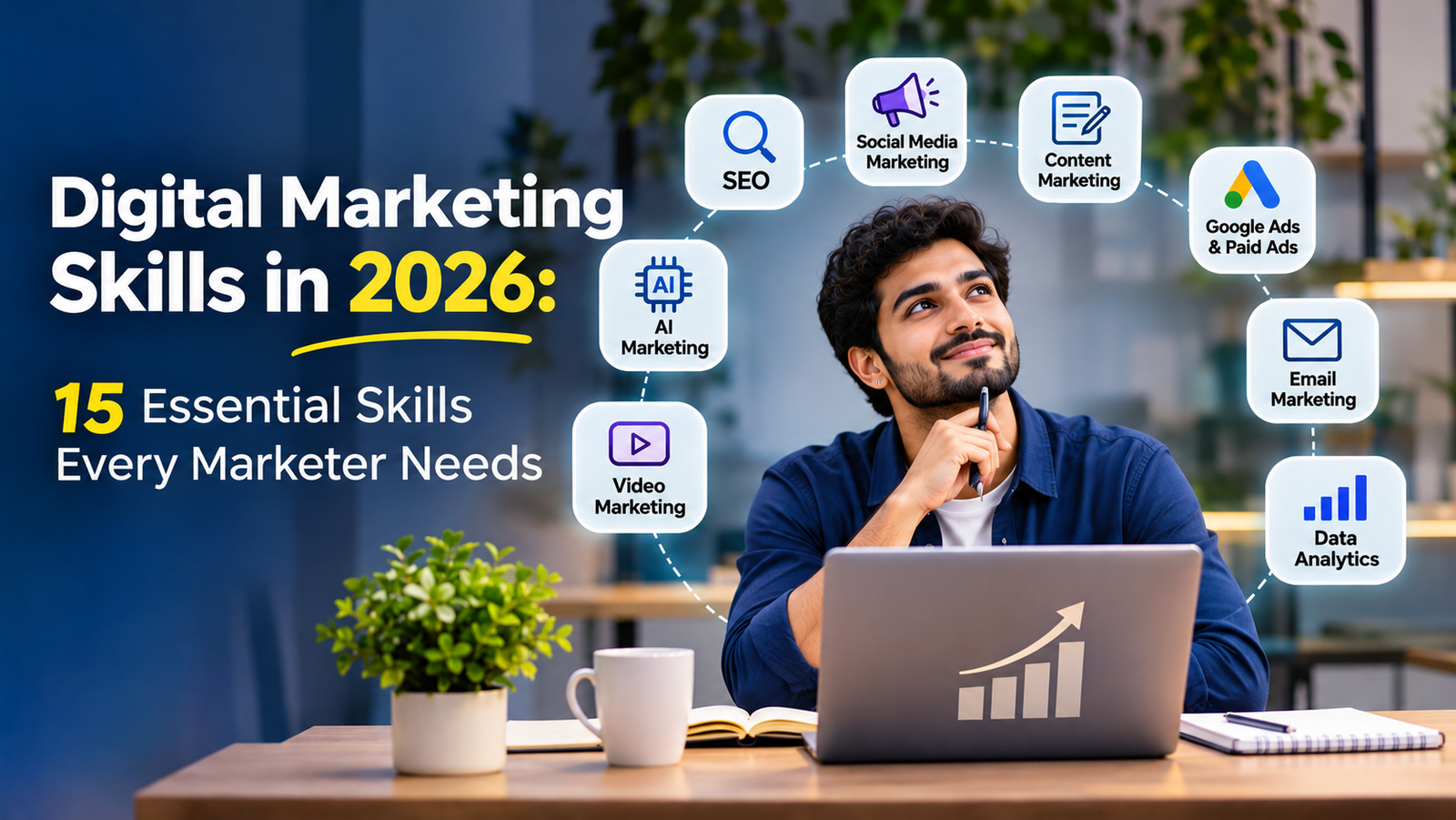
The digital world is changing faster than ever. New technologies, artificial intelligence, changing customer behaviour and updates to search engines are transforming the way businesses promote their products and services. Because of these changes, companies need marketers who can do more than just post on social media or write website content.
In 2026, a successful marketer needs a combination of technical knowledge, creativity, analytical thinking and practical experience. From SEO and social media marketing to AI tools and data analytics, the right Digital Marketing Skills can help you build a strong career and stay competitive in the industry.
Whether you are a student, a fresher, a business owner or someone planning to switch careers, learning these skills can open up several opportunities. Let’s explore the 15 essential skills every marketer should focus on in 2026.
Why Are Digital Marketing Skills Important in 2026?
Digital marketing is no longer limited to running advertisements or managing social media accounts. Businesses now use multiple online channels to reach customers, generate leads, increase sales and build long-term relationships.
Artificial intelligence is also changing everyday marketing tasks. Marketers are using AI to research topics, create content, analyse data and automate repetitive work. At the same time, businesses still need people who can make decisions, understand customers and develop creative strategies.
This means that learning digital marketing is not just about understanding tools. It is about knowing how to use them to achieve real business goals.
15 Essential Digital Marketing Skills Every Marketer Needs in 2026
1. AI Marketing Skills and Prompt Engineering
Artificial intelligence has become an important part of modern marketing. Marketers use AI tools to generate content ideas, research keywords, create campaign drafts and improve productivity.
Learning how to write clear prompts is equally important. Good prompts help you get more relevant results and reduce unnecessary editing.
You should learn how to:
Use AI tools for research and brainstorming.
Create useful prompts for different marketing tasks.
Review AI-generated content for accuracy and originality.
Use AI responsibly without losing the brand’s voice.
AI can make your work faster, but human judgement is still necessary.
2. Search Engine Optimisation (SEO) Skills
SEO helps websites appear in search engine results when people look for relevant information, products or services. It remains one of the most valuable digital marketing skills because businesses want consistent organic visibility.
A marketer should understand:
Keyword research and search intent.
On-page SEO and content optimisation.
Technical SEO basics.
Internal linking and link-building principles.
Local SEO and website performance.
Search is also changing with AI-generated answers. Marketers should create helpful, reliable content that answers users’ questions clearly instead of focusing only on keyword placement.
3. Social Media Marketing Skills
Social media platforms help brands connect with their audiences, build communities and promote products or services. A marketer should understand how different platforms work and how users behave on them.
Important social media skills include:
Planning a content calendar.
Creating platform-specific posts.
Understanding audience engagement.
Managing comments and messages.
Tracking reach, engagement and conversions.
Posting regularly is not enough. You also need a clear strategy and an understanding of what your audience wants to see.
4. Content Marketing and Copywriting Skills
Content marketing involves creating useful content that attracts and informs potential customers. Copywriting focuses on using words to encourage people to take action.
Both are important for successful marketing campaigns.
You should learn how to write:
SEO-friendly blogs and articles.
Website landing page content.
Social media captions.
Email campaigns.
Product descriptions and advertisements.
Good content should be easy to understand, relevant to the audience and connected to a clear purpose. Avoid writing only to include keywords.
5. Data Analytics and Interpretation Skills
Marketing decisions should be based on more than assumptions. Data analytics helps marketers understand what is working, what needs improvement and where a campaign is losing potential customers.
You should become familiar with tools such as Google Analytics 4 and Google Search Console.
Learn to understand metrics such as:
Website traffic and traffic sources.
Click-through rate (CTR).
Conversion rate.
Engagement and user behaviour.
Leads and customer acquisition cost.
The real skill is not just reading numbers. It is understanding what those numbers mean and deciding what to do next.
6. Google Ads and Paid Advertising Skills
Paid advertising allows businesses to reach potential customers through targeted campaigns. Google Ads is widely used to promote products and services when people are actively searching for them.
A marketer should understand campaign structure, keyword targeting, bidding, ad copy, audience selection and conversion tracking.
You should also learn how to:
Set campaign objectives.
Manage advertising budgets.
Test different advertisements.
Monitor campaign performance.
Improve results using data.
Practical experience with small campaigns can help you understand how paid advertising works in real situations.
7. Meta Ads and Social Media Advertising Skills
Organic social media helps build an audience, while paid social media advertising can help brands reach specific groups of people.
Meta Ads skills are useful for businesses that want to advertise across Facebook and Instagram. Marketers should understand campaign objectives, audience targeting, creative formats, budgets and performance reports.
Learning how to test different creatives and audiences can help you improve campaign results. You should also understand how to track leads, purchases and other important actions.
8. Email Marketing and Automation Skills
Email marketing helps businesses stay connected with people who have shown interest in their products or services. It can be used for newsletters, offers, product updates and customer follow-ups.
Automation makes this process more efficient by sending relevant messages based on user actions.
Important email marketing skills include:
Building and organising email lists.
Writing engaging subject lines.
Creating personalised campaigns.
Setting up automated email sequences.
Measuring open rates, clicks and conversions.
The goal is to send useful messages at the right time rather than filling inboxes with unnecessary promotions.
9. Video Marketing and Short-Form Video Skills
Video has become an important format for explaining products, sharing information and attracting attention on digital platforms.
Marketers should understand how to plan and create videos for platforms such as Instagram, YouTube and other short-form video channels.
Useful skills include scripting, basic editing, storytelling, captions and understanding platform formats. You should also learn to study video performance through views, watch time and audience engagement.
You do not always need expensive equipment. A clear idea and a well-planned video can make a strong impression.
10. Graphic Design and Visual Communication Skills
Visual content helps brands communicate messages quickly. Marketers who understand basic graphic design can create better social media posts, advertisements, presentations and promotional materials.
You can begin with tools such as Canva and gradually learn more advanced design software if your role requires it.
Focus on:
Choosing suitable colours and fonts.
Maintaining brand consistency.
Creating clear layouts.
Designing social media creatives.
Understanding visual hierarchy.
Good design is not only about appearance. It should make the message easier to understand.
11. Customer Relationship Management (CRM) Skills
CRM tools help businesses manage customer information, track leads and maintain relationships throughout the sales process.
A marketer should understand how to organise customer data, monitor lead progress and use customer information to create more relevant communication.
Learning the basics of CRM platforms and lead management can help you work more effectively with sales and customer support teams.
12. Marketing Automation Skills
Marketing automation helps businesses manage repetitive marketing activities through predefined workflows. These can include email follow-ups, lead notifications, customer segmentation and campaign scheduling.
In 2026, automation knowledge is useful because businesses want to save time while maintaining consistent communication.
Start by understanding how workflows operate, when automation is useful and how to check whether automated campaigns are delivering the expected results.
13. Conversion Rate Optimisation (CRO) Skills
Getting visitors to a website is only one part of digital marketing. You also need to help those visitors take meaningful actions, such as filling out a form, making a purchase or requesting a consultation.
Conversion rate optimisation focuses on improving the percentage of visitors who complete these actions.
Useful CRO skills include:
Understanding user behaviour.
Improving landing page content.
Making calls to action clearer.
Testing page layouts and headlines.
Identifying points where users leave a website.
Small improvements to a landing page can make a meaningful difference to campaign performance.
14. Communication and Strategic Thinking Skills
Technical knowledge is important, but marketers also need strong communication skills. You may have to explain campaign results, discuss ideas with clients, coordinate with designers or present a marketing plan to a team.
Strategic thinking helps you connect individual marketing activities with larger business goals.
Work on listening, presenting ideas clearly, solving problems and adapting your plans when results change. These human skills help marketers make better decisions, especially when working with AI tools.
15. Adaptability and Continuous Learning Skills
Digital platforms, tools and customer expectations keep changing. A strategy that works today may need adjustments tomorrow.
That is why adaptability is one of the most important skills for a marketer in 2026.
Make learning a regular habit. Follow industry updates, practise with new tools, review campaign results and experiment with different approaches. You do not need to master every new platform, but you should be willing to understand changes that affect your work.
How to Develop Digital Marketing Skills with Practical Experience
Reading about marketing is a good starting point, but practical work helps you understand how these skills are used.
Here are a few ways to begin:
Create a practice website: Learn basic SEO, content creation and website optimisation.
Manage a social media page: Plan posts, publish content and study engagement.
Run a sample advertising campaign: Understand campaign setup, targeting and reporting.
Build a sample email campaign: Practise writing emails and creating a simple automation flow.
Work on a portfolio: Save your projects, reports, creatives and campaign examples.
Keep learning: Follow industry updates and practise with relevant tools.
You can also join a structured training programme that combines concepts with hands-on projects. This can help beginners understand how different marketing channels work together.
How to Choose the Right Digital Marketing Skills Course in 2026
If you are planning to learn Digital Markeiting, choose a course based on what you want to achieve. A useful programme should cover important marketing areas and give you opportunities to practise what you learn.
Before enrolling, check whether the course includes:
SEO, social media and content marketing.
Google Ads and Meta Ads fundamentals.
AI tools and marketing automation.
Analytics and campaign reporting.
Practical assignments and live projects.
Guidance on building a portfolio and preparing for job opportunities.
Do not choose a course only because it promises a certificate. Focus on the knowledge, practical experience and support you will receive.
Build the Right Digital Marketing Skills for Your Future
The marketing industry in 2026 needs people who can combine technology, creativity and strategic thinking. From AI and SEO to paid advertising, analytics and communication, each skill plays a role in helping businesses grow online.
You do not have to master all 15 areas at once. Start with the fundamentals, practise regularly and gradually build expertise in the areas that match your career goals.
If you are ready to begin your learning journey, Vidyasarthi can help you take the next step. Explore the learning options available at Vidyasarthi and work towards building practical knowledge for a career in digital marketing.
Frequently Asked Questions
What are the most important digital marketing skills to learn in 2026?
Some of the most important digital marketing skills in 2026 include SEO, AI marketing, social media marketing, content creation, Google Ads, email marketing, data analytics, video marketing and marketing automation. Learning these skills can help you understand different marketing channels and build a strong career.
Can I learn digital marketing skills without any technical background?
Yes! You can learn digital marketing without a technical background. Start with basic concepts such as SEO, social media marketing and content creation. With regular practice, practical projects and the right guidance, you can gradually develop the technical and analytical skills required for digital marketing roles.
How can I develop digital marketing skills and get a job in 2026?
You can develop digital marketing skills by enrolling in a structured course, practising with real or sample projects, learning industry tools and building a portfolio. Gain practical experience in SEO, social media, paid advertising and analytics. A strong portfolio can help you demonstrate your abilities to potential employers.
Which digital marketing skill has the highest demand in 2026?
SEO, AI marketing, data analytics, paid advertising and social media marketing are valuable skills in today’s digital industry. The demand for each skill depends on business needs and job roles. Learning a combination of these skills can improve your career opportunities.
How long does it take to learn digital marketing skills?
The time required depends on your learning pace, practice and the skills you want to develop. You can understand the basics in a few weeks, but becoming confident with tools, campaigns and analytics requires consistent practice and hands-on experience.